Eduqas · GCSE · English Literature
Section C (20%) Unseen Poetry
Mastering unseen poetry isn't about memorising facts; it's about trusting your analytical skills. This guide will equip you with the SMILE method to confidently deconstruct any poem, compare effectively, and secure top marks in Section C.
- 4 min read
- 2 worked examples
- 4 practice questions
- 8 key terms
Study Notes
Overview
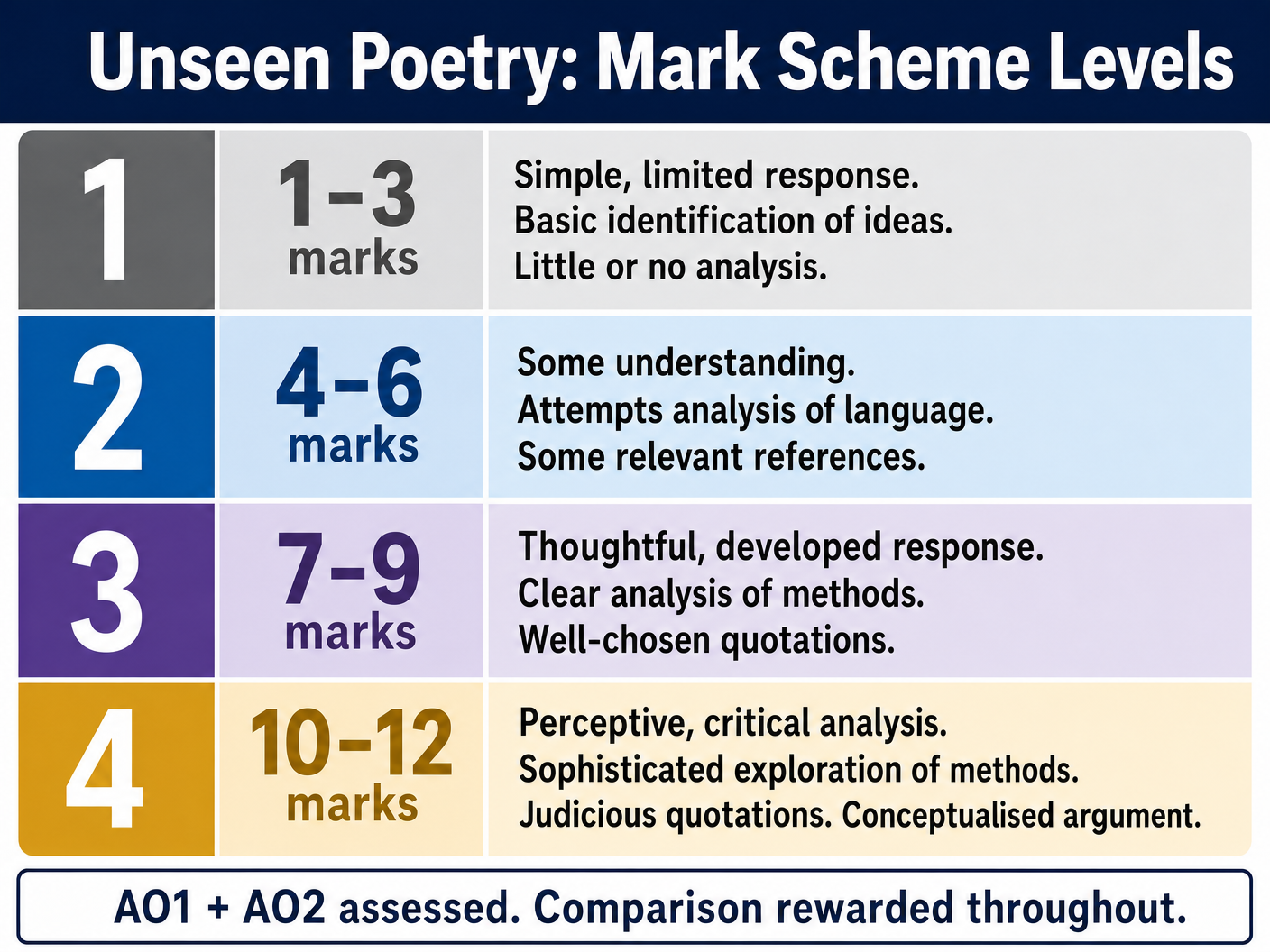
Section C (Unseen Poetry) of your English Literature exam is worth 20% of the total qualification. You will be presented with two poems you have never studied before. The exam tests your ability to independently analyse and compare how writers use language, structure, and form to create meaning and effects. Examiners are looking for a conceptualised, personal response (AO1) supported by perceptive analysis of the writer's methods (AO2). Unlike other sections, there is no requirement to discuss historical or biographical context (AO3). The key to success is a confident, comparative approach that moves beyond simple feature-spotting to explore the profound effect on the reader.
Listen to our 10-minute audio guide for a comprehensive breakdown of the exam strategy:

The SMILE Analysis Method
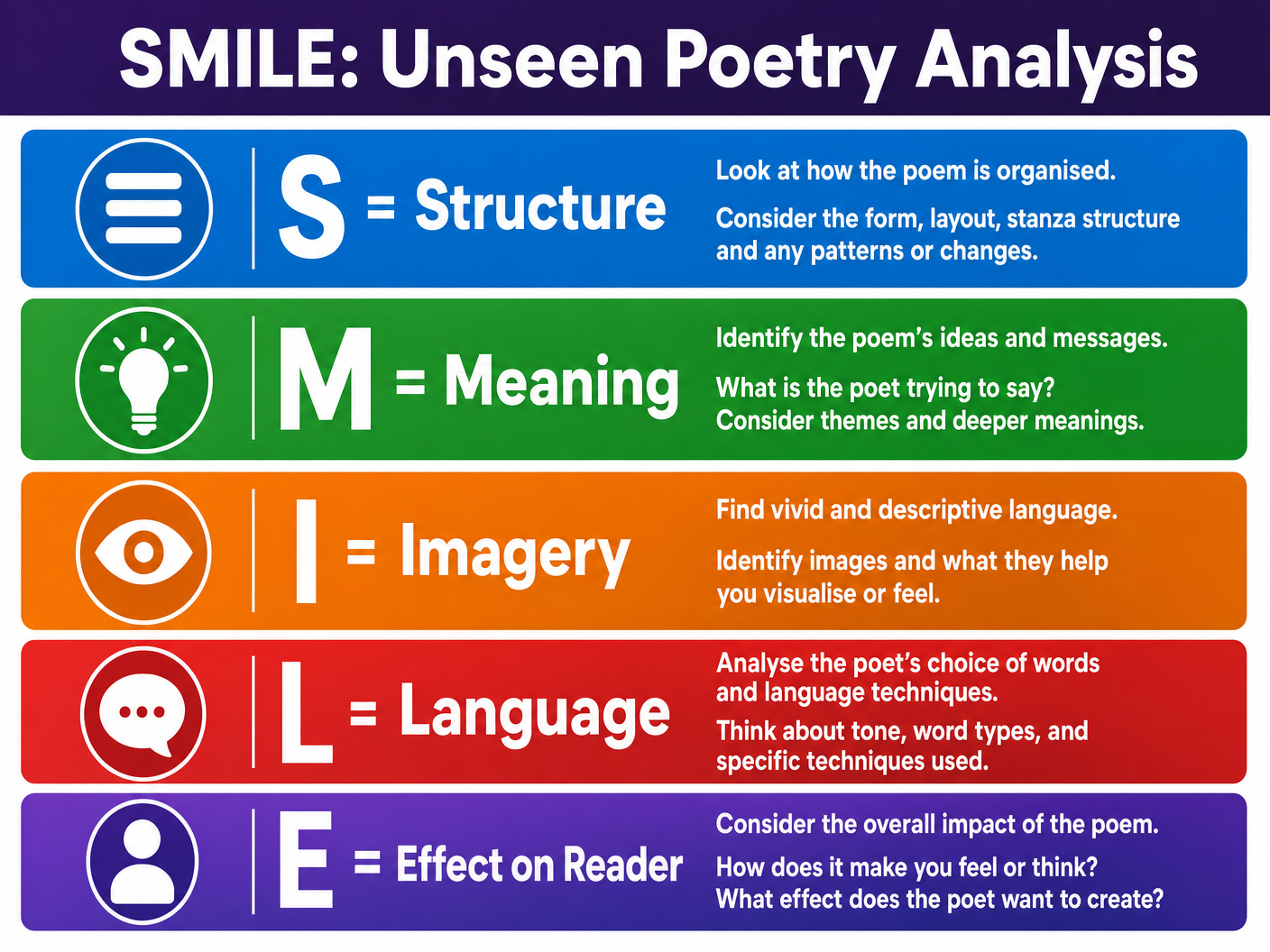
When faced with an unseen poem, candidates often panic. The SMILE method provides a reliable framework for your initial reading and annotation.
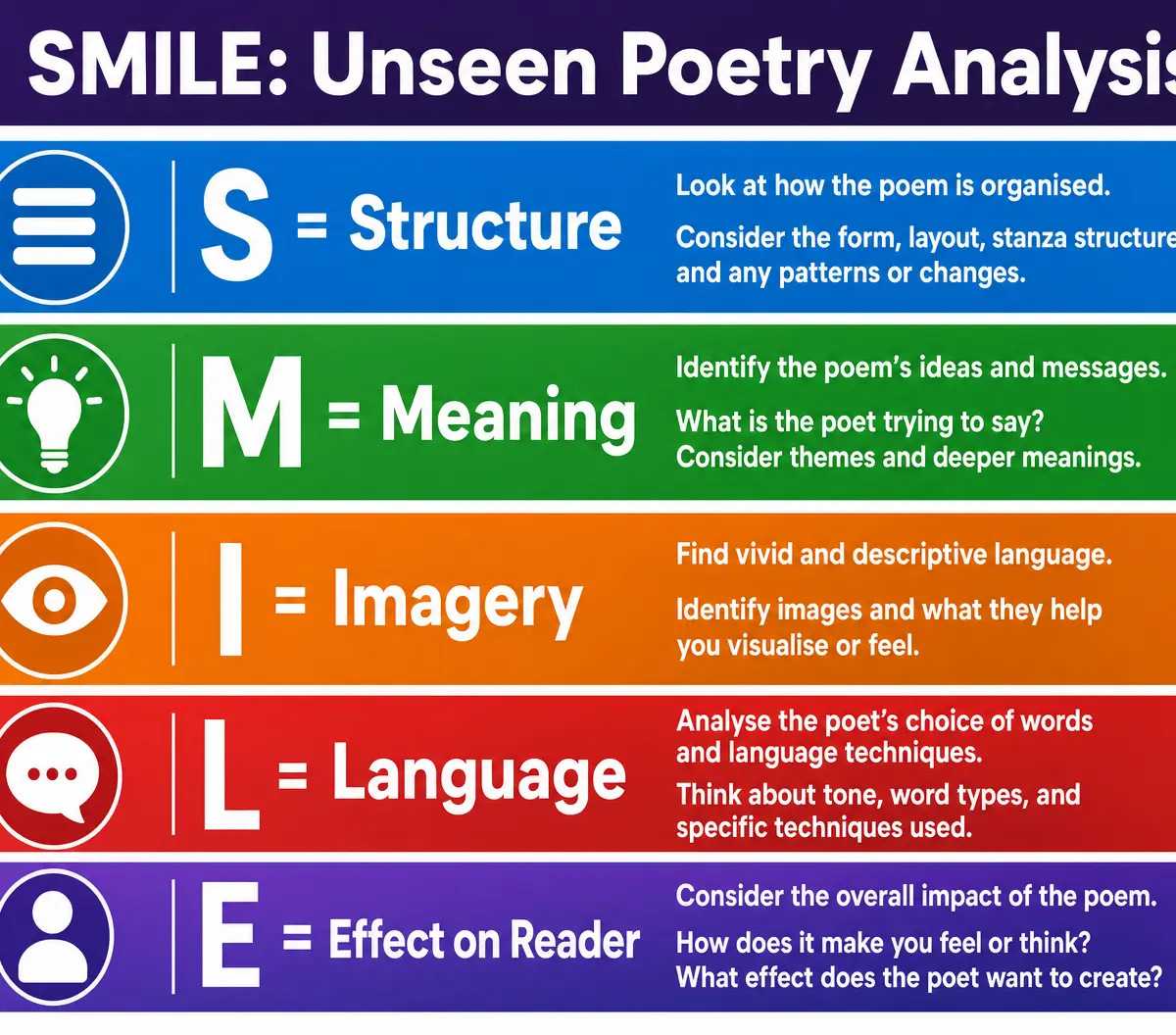
Structure (S)
Look at how the poem is organised on the page. How many stanzas are there? Are they regular or irregular? Does the poem use a specific form, like a sonnet or a dramatic monologue? Look for a volta (a turning point) where the mood or argument shifts. Examiners heavily reward candidates who analyse structure, as it is often overlooked in favour of language.
Meaning (M)
What is the poem literally about? What is the deeper, symbolic meaning? A poem about a storm might literally describe weather, but metaphorically it could represent emotional turmoil or conflict. Always push beyond the surface meaning to explore the poet's underlying message.
Imagery (I)
Identify vivid and descriptive language that creates pictures in the reader's mind. Look for similes, metaphors, and personification. Don't just spot the technique; explain why the poet chose that specific image and what it suggests about the subject.
Language (L)
Zoom in on specific word choices. Analyse verbs for action and power, and adjectives for tone and mood. Look for sound techniques like alliteration, sibilance, and assonance. Use precise subject terminology when discussing these choices, and always consider the connotations of individual words.
Effect on Reader (E)
This is the most crucial step. Every point you make about structure, meaning, imagery, or language must connect back to the effect on the reader. How does it make the reader feel? What does it make them think? How does it reinforce the poem's overall theme?
The Art of Comparison
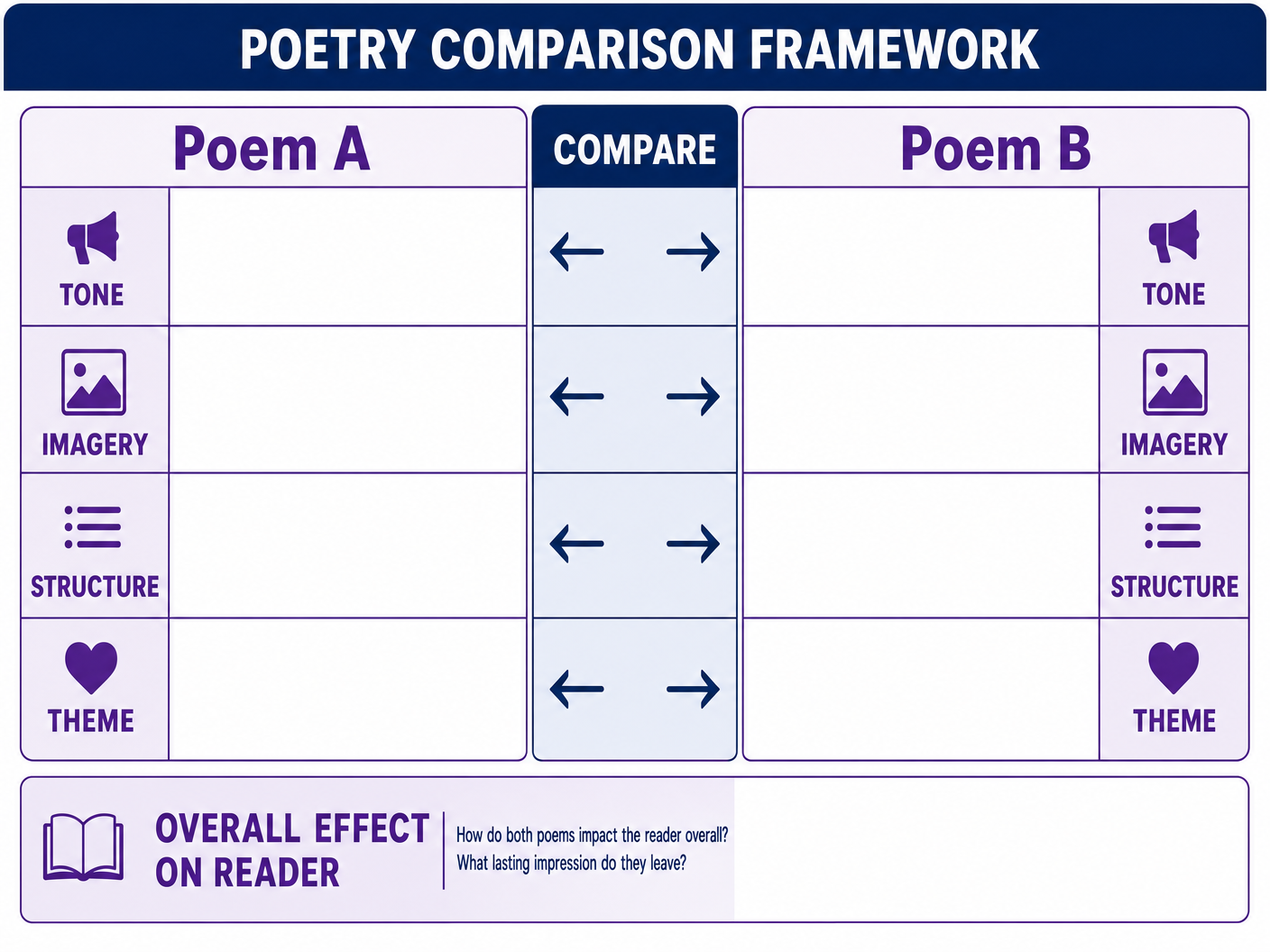
The most significant challenge in Section C is comparing the two poems effectively. Examiners award the highest marks to candidates who weave comparison throughout their response, rather than writing about one poem and then the other sequentially.
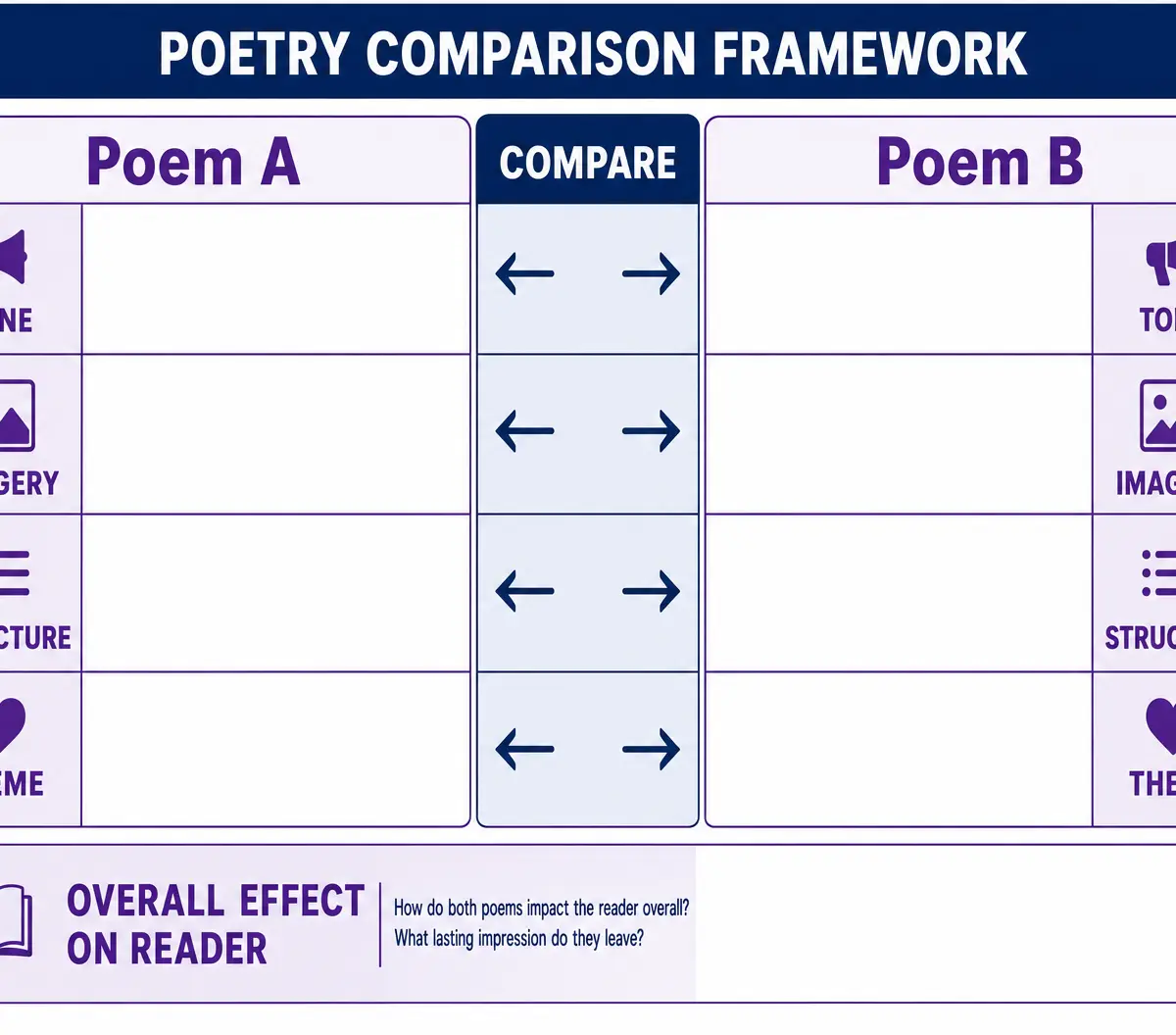
Use comparative connectives consistently: 'Similarly', 'In contrast', 'Whereas', 'Both poets explore', 'Conversely'. A strong comparative paragraph will introduce a shared theme or difference, analyse a quotation from Poem A, use a connective, analyse a quotation from Poem B, and conclude by evaluating the differing effects on the reader.
Visual Resources
3 diagrams and illustrations
Interactive Diagrams
1 interactive diagram to visualise key concepts
Conceptual Flow Outline
Workflow for tackling the Unseen Poetry comparative essay.
Worked Examples
2 worked examples — open one to explore the question and available guidance.
Practice Questions
Test your understanding — click to reveal model answers
Read the two unseen poems provided by your teacher. In both poems, the speakers describe the experience of growing older. Compare how the poets present these experiences. (24 marks)
Hint: Consider the tone of each speaker. Is one nostalgic while the other is regretful? Look for structural shifts that might represent the passing of time.
Read the unseen poem provided. How does the poet present the speaker's feelings about a childhood memory? (24 marks)
Hint: Focus on the sensory language used to describe the memory. Does the structure of the poem reflect how memories work (e.g., fragmented stanzas)?
In both 'Poem X' and 'Poem Y', the poets explore the power of nature. Compare how the poets present the power of nature. (24 marks)
Hint: Is nature presented as a destructive force, a healing presence, or something indifferent to humanity? Compare the semantic fields used in both poems.
Read the unseen poem provided. How does the poet use structure and form to convey the speaker's panic? (24 marks)
Hint: Look beyond the words. How does the layout on the page, the punctuation, and the line lengths create a feeling of breathlessness or chaos?